Part 1: How a Jarvis Clip Turned Into Five Agents on a Pi
- Vignesh Pai
- Engineering
- May 20, 2026
It started, like most of my bad ideas, with the Insta algorithm.
Clip after clip of someone’s Jarvis. You know the genre. A calm voice, a glowing UI, a guy saying “hey, deploy that” and a machine just… doing it. The feed had me segmented, profiled and served, and the feed was not wrong. After enough of those, I was sold. I wanted one.
Naturally.
This was back in March, when the whole space was on fire.
Everyone was playing with OpenClaw. I jumped in with all the hype, used it, poked at it, and within about a week hit the obvious wall: this thing needs an interface. A pile of agents with no way to see them or talk to them isn’t a Jarvis. It’s a log file with ambition.
So, in the grand tradition of every developer who should have just used the existing tool, I decided to build the interface myself.
I called it Clawsutra.
(Yes. The name came first. I had the name before I had the repo, which is how a non-trivial number of companies get incorporated. Don’t look at me like that, you’d have used it too.)
Clawsutra was, in my head, beautiful. A React Flow canvas where you’d drag out agents as nodes and wire them up, this agent to that Discord channel, this channel to that agent, draw the lines, watch it come alive. A control board for your little robot org, with the reporting lines as actual lines.
I started building it with Codex.
Then a friend mentioned Claude Code could do this sort of thing. I tried it, mostly to confirm I’d already made the right call.
There was no going back to Codex.
That’s the whole bake-off. One afternoon, two vendors, no scorecard. I’m sorry, Codex. It’s not you. It’s that the other one was better.
For a few weeks Clawsutra was the best thing I’d ever built. I had the canvas. I had channels wiring up to agents. I had skills. I’d just discovered Claude skills and gone a little feral building them. Every day it got prettier. Every day the scope grew one notch and the ship date moved two.
One more thing.
Just one more.
And that, friends, is the sound of a man walking directly into The Perfection Trap.
Here’s what The Perfection Trap feels like from the inside: it feels like diligence.
It doesn’t feel like avoidance. It feels responsible. It reads tremendously well in a status update. “I can’t ship it yet, the node-dragging is janky.” “I can’t ship it yet, the theming isn’t consistent.” Each excuse is individually reasonable. Stacked together they’re a very tidy way of never letting anyone tell you your baby is ugly.
I was optimising a hot path nobody had ever hit.
Then one afternoon I looked up and actually saw the landscape.
It was not a good look.
There were a hundred other agentic frameworks. A hundred other people building the exact node-and-wire visualization I thought was my clever idea. I wasn’t building something new. I was building another CrewAI, lovingly, carefully, in a very crowded quadrant a hundred other enthusiasts were also standing in.
And the ground was shifting under all of us at once. The OpenClaw founder went to OpenAI. OpenClaw itself pivoted to foundation-led, which is the industry’s gentlest way of saying the roadmap now belongs to a committee. The hobbyist energy that had made the whole thing feel like a movement just… frizzled. Went dormant. Tabs quietly closed all over the world.
Mine too. Clawsutra went dark right alongside everyone else’s.
So I stopped.
Not dramatically. No grand farewell post. I thought about every commute home where I’d rushed back just to make one more tweak to Clawsutra, one prop, one line, like the app would notice if it waited till morning. None of those trips mattered anymore. I just put Clawsutra down and sat with the uncomfortable thing underneath all of it, the ache I still haven’t fully shaken.
I’m never first into the market.
That’s my flaw, if you want the honest version. By the time I’ve made something beautiful, three people have shipped something ugly that works, with a room left over for polish. A banquet hall of a room. I plan beautifully. I love planning. Genuinely, the planning is the part I’d do for free. But planning is also the most comfortable place to hide. I could sit in discovery for a full quarter and file it as progress.
So I made myself a deal. Less canvas. More shipping. Build the apps, even the ones that feel a little too early, even the ones that aren’t fully baked. Ship at 0.1 and let reality file the bugs.
Some are too early. Some are quietly maturing. That’s the deal.
Which brings me to my desk, today, and the thing the Jarvis clips were actually promising the whole time.
I didn’t build the Jarvis. I built a small office of them.
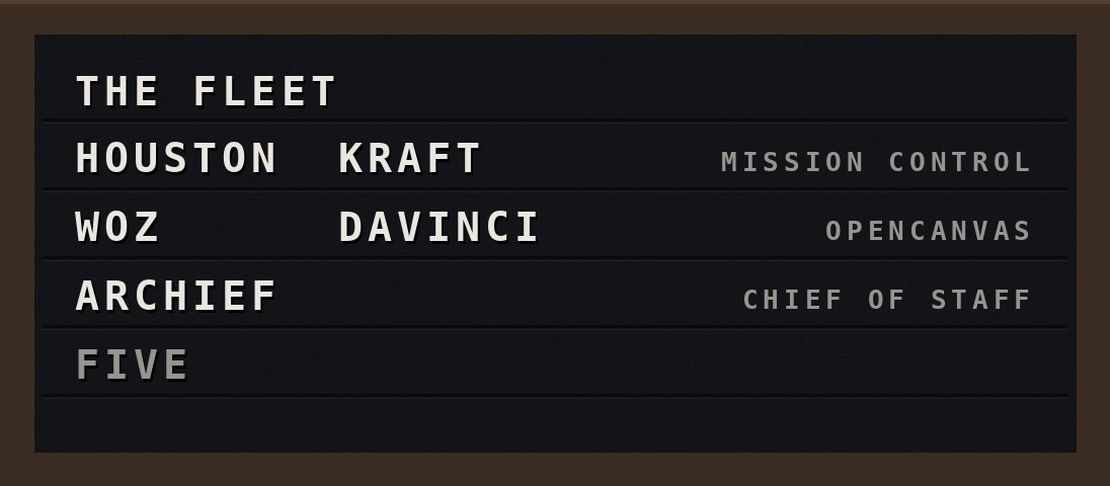
Five agents, living on a Raspberry Pi under my desk, talking back to me on Discord. There’s Houston and Kraft, who run Mission Control. Woz and Davinci, on Opencanvas. And Archief, my chief of staff, the one who orchestrates the rest, who I actually talk to, who fans the work out and rolls the status back up.
It’s not a glowing sci-fi UI. It’s a Discord server and a credit-card computer warm to the touch.
But it’s mine, it’s real, and it works.
Mostly.
Which is the part I have to tell you about.
Because earlier this week I pushed up a change I was rather pleased with, and someone in the channel requested changes. Not a nit. A sharp question I didn’t have a clean answer for. Made me defend the design. Made me a little annoyed, honestly, the way only a good critique can.
And then I remembered.
Nobody in that channel was human.
(Continued in Part 2.)